

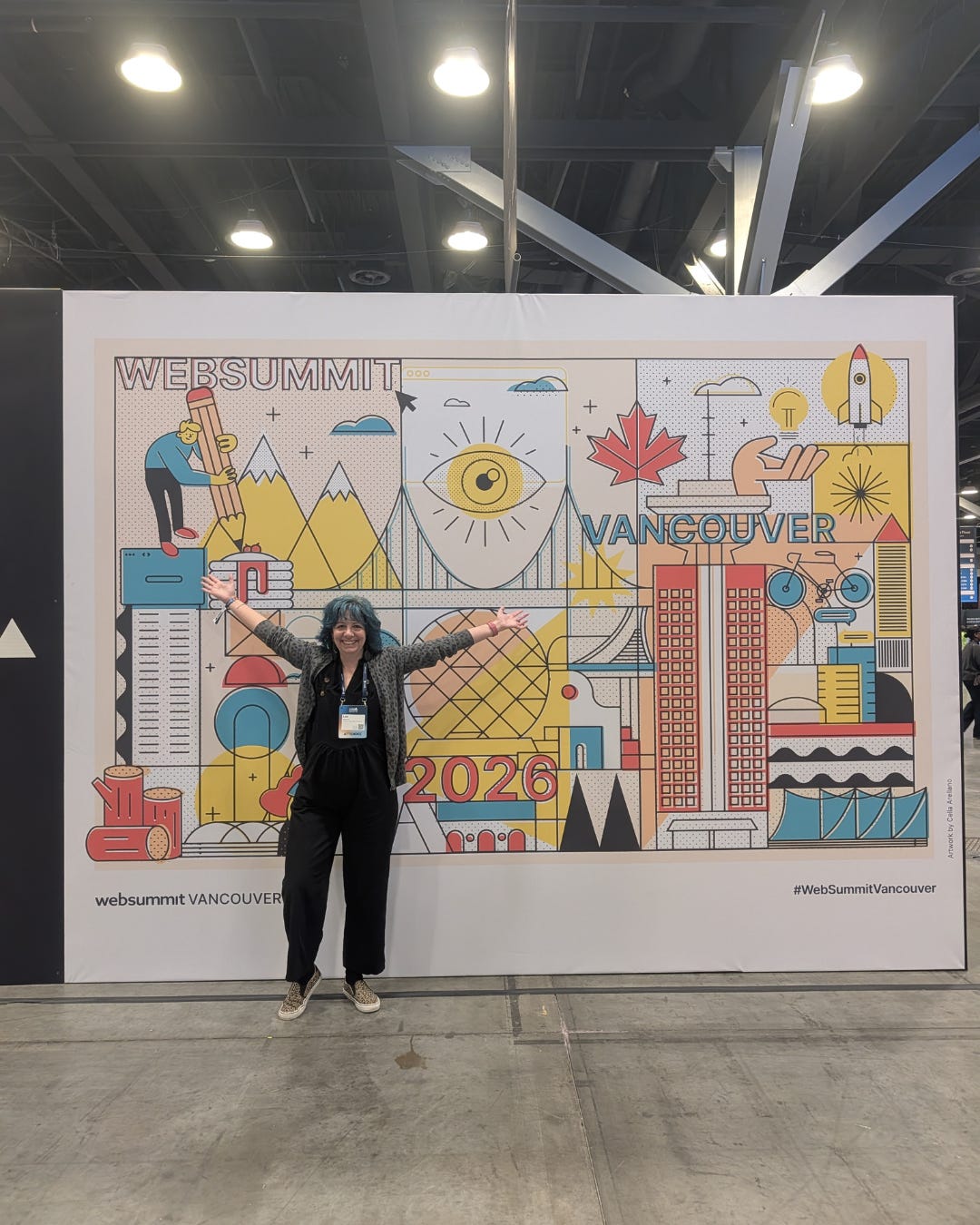
First off where the hell have I been? I’m so sorry to have ghosted you dear listeners.
I went through a nasty cough/throat sickness and lost my voice for a little bit. And then I went to Web Summit which was awesome, but left me in analysis paralysis for a couple of weeks.
So much like the dudes you find on dating apps this is me crawling back with my “you up?” text. Only with much more class and way less sleaze.
So if you’ve stuck around and forgiven me, let’s talk about the trust crisis in marketing.
People are looking for proof that there is a real human behind the business.
I have been saying this to clients for years in different ways. Show up as yourself. Be the face of your business. Let people see the person behind the offer. Stop trying to create content that looks perfect but feels like it could belong to absolutely anyone.
Then I went to Web Summit and heard this message coming from the stage again and again. Demand for content created by humans is higher than it has ever been. People are tired of AI slop, recycled ideas, and content that feels detached from any real lived experience. Visibility is still incredibly important, but the game has changed. We have to be much more ruthless about what matters, and what matters right now is creation that feels human, useful, grounded, and real.
And I don’t think most people would describe it that way when they are scrolling. They probably are not opening Instagram and saying, “I am searching for evidence of humanity today.” That would be a lot before coffee. But I do think that is what is happening under the surface.
People are taking in so much content every day. They are seeing offers, opinions, polished brand photos, trending audios, captions, videos, carousels, ads, launches, and people telling them what they should be doing in their businesses and their lives. After a while, your brain starts sorting through it. This person feels real. This person feels forced. This person seems like they have actually done what they are talking about. This person seems like they are repeating something they saw somewhere else.
That sorting process is getting sharper.
For a long time, online marketing has been very focused on attention. Get the hook right. Stop the scroll. Use the trend. Say the clever thing. Make the post look polished enough that people take you seriously. Get more eyeballs on the business.
I still believe visibility matters. I mean, I talk all the time about not wanting to be the best-kept secret, because nobody can buy from the best-kept secret. People need to know you exist. They need to see your face, understand what you do, and start to recognize you.
But attention by itself is not enough anymore.
Someone can pause on your post and still not trust you. They can watch your reel and still not feel connected to you. They can read a caption that sounds perfectly fine and still wonder if there is any real substance behind it.
That is where the trust crisis shows up.
It is not only that people are skeptical because of AI, although that is definitely part of it. We have all seen content where we are not totally sure if it was created by a person or generated by a tool, and there is often this weird little icky feeling that comes with it. Something feels off. Something feels too smooth, too generic, or too disconnected from the person supposedly saying it.
People are tired of content that tells a false story.
Audiences want to know who is behind the message. They want to know if you have been in the room, if you have done the work, if you understand the problem beyond the surface level, and if your advice has fingerprints on it.
That is why your lived experience matters so much.
If you are a business owner, you know things that cannot be pulled from a generic Chat GPT prompt. Because AI has no idea what questions your clients ask when they are almost ready to buy but still nervous or what the biggest misunderstanding in your industry is. You know what they are embarrassed to admit. You understand what they need to hear before they feel safe making a decision and you have first hand knowledge of the transformation that happens once someone agrees to work with you.
That knowledge is valuable, but a lot of business owners skip right past it because it feels ordinary to them.
They think they need to sound more professional, more polished, or more like the big brands they admire. They sit down to create content and suddenly all of the personality gets smoothed out. The words get stiff. The stories disappear. The opinion gets softened until it barely says anything. The post may look nice, but it does not give anyone a real reason to believe them.
That is one of the biggest mistakes I see.
Business owners are often so worried about bothering people, showing up too much, being judged, or saying the wrong thing that they end up hiding the exact parts of themselves their audience would connect with.
I understand that fear. Nobody wants to feel annoying. Nobody wants to post something and then sit there wondering if everyone is secretly rolling their eyes. And for a lot of business owners, especially service providers, there is also this worry that being too personal will make them look unprofessional.
That is where we need a bit of nuance.
Being authentic does not mean showing every detail of your personal life. It does not mean sharing things before you have processed them. It does not mean posting your entire emotional experience for the sake of engagement. I am not a fan of oversharing dressed up as marketing, and I also do not think “being real” means you show up looking like you rolled out of bed and forgot you run a business.
There is a difference between being human and being careless.
I want to feel the person behind the business, but I still want to trust that they can handle the job. If I am hiring someone for business services, I do not really want to feel like I am hiring someone who showed up in pajama energy. That might sound a little blunt, but it is true. Authenticity still needs discernment.
To me, authenticity is alignment. It is the feeling that the person I am seeing online is connected to the person I would meet in real life. It is the sense that your message, your values, your tone, your client experience, and the way you treat people all belong together.
That kind of alignment builds trust.
And people are watching for it, even if they do not realize that is what they are doing. If you say community matters to you, people will notice whether they feel included when they interact with you. If you say you care about client experience, they will notice whether your process feels supportive. If you talk about confidence, they will notice whether you help people feel more capable or whether your content leaves them feeling behind.
The words are one piece of it. The behaviour is the proof.
This is why I think thought leadership has become such an important part of marketing, but I also think we need to bring that phrase down to earth a little.
Thought leadership can sound very big and fancy, like it belongs to someone on a stage with perfect lighting and a headset microphone. But real thought leadership is much more human than that. It is using your own experience and lessons to help other people shift the way they see something, make a better decision, or move forward with more confidence.
That is it.
Start paying attention to what your work is teaching you and being willing to share the lesson in a way that helps someone else.
A photographer learns pretty quickly that most clients are not actually worried about having the perfect outfit before a brand shoot. What they really need is to feel safe being seen. A bookkeeper hears the stories behind the messy numbers and starts to understand that avoidance is often tied to shame, not laziness. And as a social media strategist, I see this all the time with content. A business owner thinks they need to sound more professional, when the real issue is that they have taken too much of themselves out of the message.
Those observations are thought leadership.
They come from experience. They come from listening. They come from doing the work with real people and noticing patterns.
This is also makes personal stories are so useful in marketing when they are handled well. A story does not have to be dramatic to matter. Sometimes the strongest stories are the small ones that show people how you think.
For me, one of the most popular things I do is take my audience on walks with me. I will be outside, phone in hand, talking about my day, something I am curious about, what I am working on, or a thought that has been rolling around in my brain. It is not overly produced. It is not perfect. Sometimes the lighting is not amazing. Sometimes I am literally walking and talking at the same time, which means it has a bit more real life in it.
And people respond to those videos.
I have had people tell me they love coming along on those little walks. They feel like we are having a chat. They get to hear what I am thinking about in real time, and it creates a sense of connection that a perfectly polished graphic would not create in the same way.
That does not mean everyone needs to make walk-and-talk videos. That works for me because it fits who I am and how I naturally communicate. The bigger lesson is that people connect with content that lets them feel a real person behind it.
That is what I help clients do too.
A big part of my work is making businesses feel more human to their audience. Not less professional, not messy, not random, but more recognizable as an actual person or team that cares about the work they do. When a business starts showing more behind the scenes, more real stories, more client questions, more personality, and more thoughtful perspective, it becomes easier for people to understand who they are trusting.
And trust is the piece that changes everything.
People may find you because of visibility, but they come closer because of trust. They may notice a post because it is polished, but they remember the story that made them feel understood. They may enjoy the trend, but they hire the person who feels steady, capable, and real.
This is where consistency comes in, and I do not only mean consistency in the “post three times a week” way.
A posting schedule can help, but consistency is bigger than that. It is being consistent in your values, your message, your client experience, your tone, and the way people feel when they interact with you over time.
That kind of consistency creates safety.
When someone is deciding whether to hire you, refer you, collaborate with you, or buy from you, they are often asking themselves whether they can count on you. Your content helps answer that question before they ever reach out.
They see how you talk about your work. They see how you respond to people. They see whether your advice stays grounded or shifts every time there is a new trend. They see whether you actually seem connected to the thing you are teaching or selling.
Over time, those signals add up.
That is why I wish more business owners would stop putting so much pressure on each individual post.
One post does not determine your success or failure. If something does not land, you are allowed to learn from it and make another one tomorrow. Social media content is an experiment. You try something, you pay attention, you make adjustments, and you keep going.
You are not making mistakes every time a post underperforms. You are gathering information.
That is such a healthier way to look at content.
If you are expecting every post to prove your worth, content creation becomes exhausting. If you treat it like an experiment, it becomes much more useful. You start asking better questions. What did people respond to? What felt easy for me to create? What sparked conversation? What made someone send me a message? What did I say that felt more like me?
That is how your voice gets stronger.
Not from waiting until you have the perfect idea, the perfect outfit, the perfect lighting, the perfect confidence, and the perfect plan. Your voice gets stronger because you use it. You show up, you learn what feels aligned, and you keep refining.
This is also where ruthless prioritization comes in.
There are so many things business owners could be doing online. There are endless platforms, trends, formats, tools, content ideas, and strategies. You could spend all day trying to keep up and still feel behind. But if the demand for human-created content is higher than ever, then we need to prioritize the parts that help people trust us.
That means creating content that shows your face sometimes. It means letting people hear your perspective. It means sharing stories from your real work. It means showing behind the scenes in a way that helps people understand the business better. It means choosing connection over constant polish.
It also means knowing when to ignore the noise.
You do not have to use every trend. You do not have to post on every platform. You do not have to turn your whole life into a performance. But you do have to give people enough evidence to believe that there is a real, capable, thoughtful person behind the business.
That evidence might be a video of you explaining something in your own words. It might be a story about a client question that comes up all the time. It might be a behind-the-scenes look at how you prepare for your work. It might be a post about something you changed your mind about. It might be a simple observation from your day that connects back to a lesson your audience can use.
The format matters less than the presence behind it.
And I think that is where the future of online marketing is heading.
People are getting better at detecting content that has no real person in it. They are getting tired of generic advice, polished emptiness, and marketing that feels like it was created to satisfy an algorithm instead of serve an audience. They want original perspective. They want lived experience. They want consistency between what you say and what you do.
They want proof of humanity.
For business owners, that is actually really good news.
It means you do not have to become some glossy, overproduced version of yourself to be taken seriously. You do not have to sound like everyone else. You do not have to hide your quirks, your warmth, your sense of humour, your curiosity, or the way you naturally explain things.
You do need to be thoughtful. You do need to be discerning. You do need to remember that your audience does not need every nitty gritty detail of your life. But you can let them into the journey enough that they feel connected to the person behind the work.
That is where trust begins.
Trust begins when people can recognize you. It grows when they see you showing up with consistency. It deepens when your words and actions line up. It becomes valuable when people believe not only that you know what you are doing, but that you will care about their experience too.
And I think trust may become the most valuable asset a business can build in the next decade.
Attention can be bought, borrowed, or boosted for a moment. Reach can rise and fall. Trends come and go so quickly that half the time we are already bored of them by the time we figure out how to use them. But trust is different. Trust is what makes someone choose you when they have options. Trust is what makes someone send your name to a friend. Trust is what makes someone keep listening long after the trend has moved on.
So if you are a business owner and you have been overthinking your content, I want you to take a breath and remember that one post does not have to carry the entire weight of your business. You can try something, see how it feels, pay attention to what happens, and make another post tomorrow with a little more information than you had today.
The businesses that win in this next chapter of online marketing will not be the ones that perform humanity the best. They will be the ones that practice it, consistently, in the way they create, lead, serve, and show up.
And that might be the simplest place to start.
Show up as yourself. Let people see the face behind the business. Give them a reason to trust the human on the other side of the screen.


